
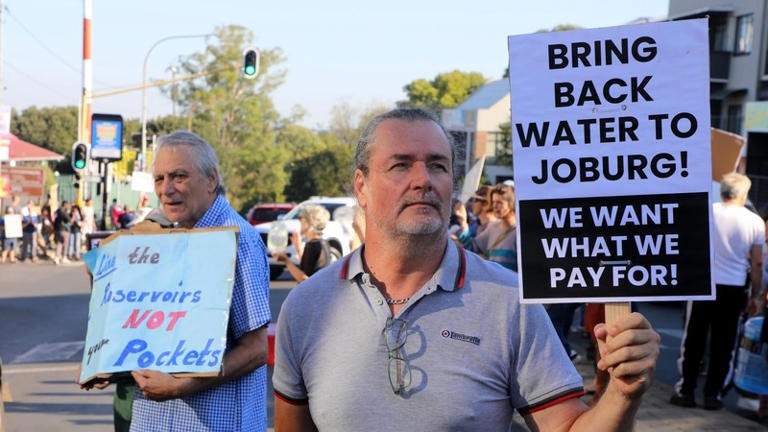
In the Johannesburg suburb of Greenside, a large group of protesters of all ages and backgrounds are waving placards and banging empty plastic bottles together
Northern Johannesburg is known for its plush leafy suburbs. But after years of intermittent water shortages, residents say they are fed up. Some have had no running water for over a month.
Another protester, Jenny Gillies, has lived in Melville for 40 years. “I am here today because it is an actual disgrace,” she says. “We are reduced to begging and protesting for water.”
From 2022 to early 2024, Johannesburg, South Africa’s economic hub, suffered crippling electricity shortages, which were managed via a process known as load shedding.
Blackouts lasting up to eight hours a day severely disrupted the lives of ordinary South Africans and businesses. Experts blamed a long-standing lack of investment in the country’s ageing power stations.
But over the past year, water shortages have become a greater concern, with some residents saying these are worse because of how essential clean water is for good health.
And Johannesburg isn’t the only area affected. In Hammanskraal, more than 100km (60 miles) north of the city, 35-year-old pastor Tshepo Mahlaule shows us a dry tap in his backyard.
Meanwhile, After the acquisition of East Africa’s biggest media outfit by a wealthy, politically well connected businessman, questions are being asked about the future of independent journalism in the region.
Every day millions of people in Kenya, Tanzania, Uganda and Rwanda turn to one of the dozens of newspapers, TV and radio stations or digital outlets owned by the Nation Media Group (NMG) for reliable news.
In countries where journalists have come under pressure from the authorities, titles such as Kenya’s Daily Nation, Tanzania’s Mwananchi or Uganda’s Daily Monitor have become the standard-bearers for trusted information.